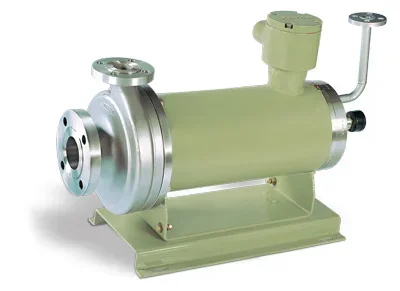


Complete Guide to Centrifugal Canned Motor Pumps
March 25, 2026
Sealless Leak-Free Pumps: Working, Benefits and Uses
March 31, 2026
Every pump has a weak point.
In most conventional centrifugal pumps, that weak point is not the impeller, not the casing, not the motor. It is the mechanical seal. That one component sitting between the rotating shaft and the outside world, holding back whatever fluid happens to be on the other side.
For water or mild process fluids, a degrading seal is an inconvenience. Scheduled replacement, some downtime, manageable cost.
But change the fluid. Make it toxic. Make it flammable. Make it a carcinogen or a volatile solvent or a radioactive coolant. Now that degrading seal is not an inconvenience. It is a liability.
That is the exact problem the sealless canned pump was designed to eliminate.
What Is a Sealless Canned Pump?
A sealless canned pump is a centrifugal pump where the motor and pump are combined into a single, hermetically sealed unit with no mechanical seal and no external shaft coupling anywhere in the assembly.
The name comes from the can, a thin cylindrical sleeve that sits between the stator and the rotor inside the pump. That sleeve is what makes hermetic operation possible. The magnetic field from the stator passes through the can and drives the rotor without any physical connection between the electrical components and the process fluid.
The process fluid itself circulates through the motor section. It lubricates the bearings. It cools the rotor. Everything the pump needs to operate is handled internally, within the sealed assembly, using the fluid that is already there.
No seal. No leakage path. No external coupling to maintain.
That is the short version. The implications of that design, operationally and economically, run considerably deeper.
Why the Absence of a Seal Changes Everything
This needs to be said clearly because it is easy to underestimate.
A mechanical seal is not just a maintenance item. It is a failure mode. Every conventional pump with a mechanical seal has a built-in timeline to its next leak. That timeline varies. It depends on fluid chemistry, temperature, pressure cycling, run hours, and a dozen other factors. But the direction of travel is always the same. Seals degrade. Seals leak. Seals fail.
In a sealless canned pump, that failure mode does not exist. Not managed. Not extended. Removed.
For industries handling hazardous, toxic, or environmentally sensitive fluids, that distinction is fundamental. You are not reducing the risk of a leak. You are eliminating the mechanism through which a leak would occur.
Regulators understand this. Safety engineers understand this. Anyone who has dealt with a seal failure in a chemical or pharmaceutical plant understands this particularly well.
How a Sealless Canned Pump Works
The operating principle is cleaner than most people expect when they first encounter it.
- Stator activation. Electrical power energises the stator windings, generating a rotating magnetic field that passes through the can.
- Rotor response. The rotor, sitting on the fluid side of the can, responds to that field and begins rotating. The impeller is on the same shaft, so it rotates immediately.
- Fluid enters. Process fluid comes in through the suction inlet, reaches the impeller eye, and gets accelerated outward by centrifugal force. Velocity converts to pressure at the volute or diffuser.
- Internal circulation loop. A controlled portion of the process fluid is directed through the motor section. It flows around the rotor, through the bearing clearances, cools the motor windings indirectly, lubricates the bearings, and returns to the main flow path.
- Discharge. Pressurised fluid exits through the discharge outlet into the downstream system.The whole sequence runs inside a closed assembly. From suction to discharge, there is no point where the fluid contacts the external environment. No gap. No seal interface. No penetration through the casing wall.
Key Components Inside a Sealless Canned Pump
Understanding what is actually inside helps when it comes to specification and maintenance decisions.
- The Can. The defining component. Thin-walled, non-magnetic, typically stainless steel or a corrosion-resistant alloy. Separates stator from rotor while allowing magnetic drive. Must be thin enough to minimise magnetic losses and strong enough to handle the pressure differential across it.
- Stator. The stationary winding set enclosed within the outer casing. Generates the rotating magnetic field that drives the rotor.
- Rotor. The rotating element on the fluid side of the can. Drives the impeller shaft directly.
- Impeller. Converts rotational energy into fluid pressure through centrifugal action.
- Product-Lubricated Bearings. Lubricated by the process fluid through the internal circulation loop. No separate lubrication system required.
- Internal Circulation Path. The engineered flow path routing fluid through the motor section for cooling and bearing lubrication before returning it to the main flow.
- Pressure Casing. The outer housing containing the entire assembly. Provides structural integrity and contains system pressure.
Each of these components contributes to the overall performance. The weakest specification in that list becomes the constraint on the whole system.
Types of Sealless Canned Pumps
Not every application involves the same conditions. The sealless canned pump family covers a meaningful range.
- Standard configuration handles moderate temperatures, moderate pressures, and clean compatible fluids. The majority of chemical and process industry applications fall here.
- High-temperature models are built for elevated process temperatures with appropriate material upgrades throughout the internal wetted path and motor assembly.
- Cryogenic variants handle liquefied gases and extremely low-temperature fluids. The thermal engineering at these extremes is substantial and the design reflects it.
- High-pressure models are built to tighter tolerances for applications where system pressure exceeds standard operating ranges considerably.
- Multistage variants incorporate multiple impeller stages within the same sealed assembly. Used where high-pressure output and hermetic containment are both required.
Where Sealless Canned Pumps Are Specified
The application profile follows directly from what the design does well.
- Chemical processing is where sealless canned pumps have the deepest footprint. Corrosive acids, chlorinated solvents, toxic intermediates, reactive compounds. Fluids where leakage triggers immediate safety and environmental consequences. Removing the leakage mechanism removes the problem at its root.
- Pharmaceutical manufacturing requires contamination control that a degrading mechanical seal cannot reliably provide over time. Clean, enclosed fluid handling is the standard. Sealless canned pumps meet it. They are also compatible with clean-in-place and sterilise-in-place procedures when correctly specified.
- Nuclear industry. This sector has used sealless canned pump technology for decades. Radioactive coolant circuits, waste transfer loops, process systems in nuclear facilities. Zero leakage is not a target here. It is the only acceptable standard. Hermetic design meets it by construction, not by maintenance schedule.
- Petrochemical and refinery operations handle volatile hydrocarbons and flammable process streams. Seal failure in these environments is a fire and explosion risk, not just a maintenance event. In hazardous area classified installations, eliminating the leakage point is a safety requirement.
- Refrigeration systems. Refrigerant loss damages both the environment and system efficiency. Closed-loop refrigerant circuits benefit directly from sealed pump operation. No leakage path means no refrigerant migration.
- Heat transfer fluid systems running thermal oils at elevated temperatures push conventional seals into accelerated degradation territory. Switching to a sealless canned pump removes that failure mode entirely.
- Water treatment and dosing. Chemical dosing systems handle aggressive reagents in precise, controlled quantities. Leakage here is simultaneously a safety issue and a process accuracy problem. Both are resolved by the sealed design.
What to Think Through Before Selecting One
Selection is not a catalogue matching exercise. It requires working through the actual operating conditions.
- Fluid characteristics come first. Chemical composition and material compatibility, temperature range across all operating states, viscosity, vapour pressure, and critically, whether any solids or abrasive particles are present. Product-lubricated bearings are sensitive to abrasives in ways that are not always immediately visible in performance data.
- Flow and head requirements determine the hydraulic operating point. That point should sit within the efficient range of the pump curve. Operating continuously far from the best efficiency point generates internal heat that the circulation loop may not adequately handle.
- NPSH available at the pump suction must exceed the pump’s requirement with proper margin. Cavitation causes internal bearing damage in sealless canned pumps that is less immediately obvious than in conventional designs. Address it at the specification stage, not during troubleshooting.
- Duty cycle affects winding thermal management. Frequent starts generate heat in the stator. Allowable start frequency limits exist and need to be part of any specification discussion for intermittent applications.
- Regulatory requirements include hazardous area classification, environmental discharge standards, and industry-specific safety codes. These often determine which design options are permissible before hydraulic selection even begins.
Maintenance Reality
Less maintenance than a sealed pump. Not zero maintenance.
Monitor winding temperature, flow and pressure performance against established baselines, and power consumption relative to expected values at the operating point. Deviations signal internal changes before they become failures.
Scheduled work includes bearing inspection at intervals informed by fluid quality and operating hours, can inspection for surface degradation or pitting, and internal circulation path checks for fouling. The schedule is more predictable than for sealed pumps. There are no unexpected seal failures creating reactive maintenance events. That predictability has direct value in any production environment where downtime is expensive.
Conclusion
The sealless canned pump holds its position across demanding industries not because it is new technology but because it solves a real problem consistently well.
Remove the seal. Remove the leakage path. Build the result into a compact, reliable assembly that handles its own cooling and lubrication using the process fluid it is already working with.
For the applications where fluid containment is genuinely non-negotiable, that design logic is difficult to argue with.
At Hydrodynepumps Teikoku, working with clients on sealless canned pump selection means starting with the fluid, the process conditions, and the regulatory environment before anything else. The pump has to fit the application properly. That is where reliable, long-term performance comes from.
FAQs
1. What is a sealless canned pump?
A centrifugal pump with no mechanical seal, where the motor and pump are enclosed in a single hermetically sealed assembly driven by magnetic coupling through a thin containment sleeve called the can.
2. How does it differ from a conventional centrifugal pump?
No mechanical seal, no external coupling, and no conventional leakage path. The process fluid lubricates and cools the motor internally.
3. What fluids are suitable?
Clean, low-viscosity fluids. Particularly hazardous, toxic, flammable, or radioactive fluids where leakage is not acceptable at any level.
4. Can sealless canned pumps run dry?
No. Dry running removes internal lubrication and cooling. Bearing damage and motor overheating follow quickly. Dry run protection is essential.
5. Are they harder to maintain?
Different, not harder. Fewer components, more predictable service intervals, no seal replacement cycles. The maintenance picture is generally simpler.
6. What is the biggest risk in operating these pumps?
Running with contaminated or abrasive fluid without adequate upstream filtration. Bearing wear from particles in the fluid is the most common cause of premature failure.
7. Is initial cost higher?
Yes, typically. Total cost of ownership over a realistic service life, accounting for maintenance savings and eliminated downtime, frequently closes that gap.