
How to Choose the Right Chemical Pump: Materials, Flow Rate & Maintenance Essentials
December 30, 2025
Latest Trends & Innovations in Canned Motor Pump Technology (2026)
February 2, 2026
This blog explains why industrial facilities choose a hermetic canned motor pump when handling hazardous media such as toxic, flammable, corrosive, or environmentally sensitive chemicals. It covers the technical reasons behind leak-free operation, how these pumps reduce risk and lifecycle costs, what operating conditions they suit best, and the key points procurement and maintenance teams should evaluate before standardizing them in critical services.
Hazardous media demands a zero-leakage pumping approach
In chemical processing plants, refineries, pharma units, and specialty manufacturing, “hazardous media” is not just a process term—it directly affects safety systems, compliance obligations, and business continuity. Even minor leakage from conventional pumps can lead to exposure risks, emission violations, product loss, or shutdowns. A hermetic canned motor pump is preferred because it is built specifically to eliminate the most common leakage path: the dynamic mechanical seal area.
The core design advantage: no mechanical seal to atmosphere
A traditional centrifugal pump typically uses mechanical seals to prevent leakage along the rotating shaft. Over time, seals face wear due to pressure changes, temperature cycling, chemical attack, dry running incidents, vibration, or improper flush conditions. Seal systems also introduce auxiliary piping and instrumentation that require ongoing attention.
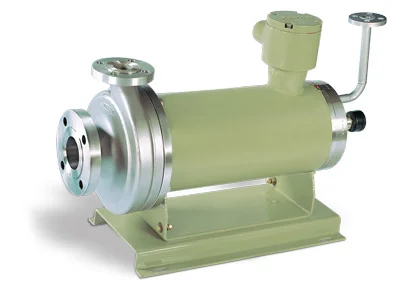
A hermetic canned motor pump removes this risk by integrating the motor and pump into a sealed unit. The motor rotor is enclosed within a “can,” and there is no shaft penetration exposed to atmosphere. In practical plant terms, this means: fewer external failure points, reduced fugitive emissions, and a safer default for hazardous service.
Reduced fugitive emissions and easier compliance alignment
Many industries operate under strict environmental and occupational safety requirements, where controlling emissions and preventing chemical exposure is non-negotiable. Plants often spend heavily on seal support plans, barrier fluids, nitrogen blanketing, and monitoring to manage leakage risk.
A hermetic canned motor pump supports compliance by design. Because it is sealed, it reduces the likelihood of emissions and helps plants maintain stronger control over hazardous chemicals during transfer and circulation duties. This is especially relevant in units where audits, reporting, and risk assessments demand measurable reduction in leak probability.
Reliability benefits for continuous-duty hazardous services
Hazardous chemical handling is rarely intermittent. Many systems run 24/7, and unplanned downtime creates a chain reaction process imbalance, batch losses, safety interventions, and production delays.
A hermetic canned motor pump is often selected for critical continuous-duty applications because the integrated construction eliminates coupling alignment issues and reduces dependence on seal-related maintenance intervals. When properly sized and operated within design limits, it provides stable performance where reliability is tied directly to operational profitability.
Common industrial applications include:
- Transfer of toxic or volatile chemicals
- Circulation of acids, solvents, or aggressive compounds
- Reactor feed lines and intermediate transfer
- Closed-loop chemical circulation systems
- Handling of high-purity or contamination-sensitive liquids
Lower external system complexity and reduced maintenance burden
From a business perspective, maintenance is not only a workshop cost—it’s also downtime cost, manpower scheduling, spares management, and operational risk. Seal-based hazardous services often require frequent monitoring of seal flush plans, barrier fluid condition, and instrumentation. Failures can be sudden and disruptive.
A hermetic canned motor pump reduces external system complexity because it eliminates seal support systems. While internal circulation and bearing lubrication must be managed correctly, the maintenance workload is often more predictable and less dependent on seal performance. This can simplify preventive maintenance planning, especially for plants operating multiple hazardous duty pumps.
Material selection supports corrosive and reactive media
Hazardous media often includes corrosive acids, reactive chemicals, and solvents that can attack standard pump materials. Material compatibility remains a top decision factor. A hermetic canned motor pump can be specified with suitable metallurgy and internal component materials aligned to the chemical, concentration, temperature, and process conditions.
For procurement teams, the right material selection is a lifecycle decision. Choosing compatible materials reduces corrosion-driven failures, protects performance stability, and helps avoid costly incidents such as internal degradation, efficiency loss, or contamination.
Business case: improved safety, reduced risk, stronger uptime
When plants select a hermetic canned motor pump, they are typically solving three business problems at once:
- Safety risk reduction through leak-free containment
- Operational continuity by removing seal-failure downtime
- Lower lifecycle costs by reducing auxiliary systems and interventions
This is why many facilities adopt hermetic technology as a standard for specific hazardous duty services rather than treating it as a special-case pump.
Final decision checklist before selecting a hermetic canned motor pump
To ensure the correct fit, decision-makers should validate:
- Chemical compatibility and operating temperature range
- Required flow rate and differential pressure
- Fluid cleanliness and allowable solids content
- Risk of dry running and the control strategy to prevent it
- Maintenance philosophy: preventive, condition-based, or critical spares strategy
Hydrodyne Pump Teikoku supports industrial users with engineered solutions where pump selection, material choice, and application fit are aligned to plant safety goals and long-term reliability expectations especially in hazardous chemical services.