
Why Chemical Plants Are Switching to API 685 Pumps: Cost vs Risk Perspective
June 21, 2026
Case Study: Eliminating Chlorine Leak Risk Using Canned Motor Pumps
June 25, 2026
Most hazardous chemical plants still calculate pump cost incorrectly.
They compare purchase price.
Not containment risk.
Not shutdown exposure.
Not fugitive emissions.
Not maintenance labour escalation.
Not corrosion spread after chronic leakage.
And definitely not the hidden cost of process instability caused by recurring seal problems.
That is why the lifecycle cost discussion around Sealless Pumps has changed so much in recent years. The debate is no longer about whether seal-less systems cost more upfront. In many hazardous services, they do. The real question is whether conventional sealed pumps actually remain cheaper after five to ten years of operation inside aggressive chemical environments.
In a surprising number of plants, the answer is no.
Why lifecycle cost matters more in hazardous service than normal industrial duty
A water transfer pump and a chlorine transfer pump cannot be evaluated using the same economic model.
Hazardous chemical service introduces additional operational layers:
- Environmental liability
- Worker exposure risk
- Emergency response planning
- Regulatory reporting
- Corrosion impact
- Process shutdown consequences
This changes how “pump failure” should be defined.
In hazardous service, failure does not begin when the pump stops running.
Failure often begins much earlier:
- Minor seal leakage
- Vapour release
- Repeated maintenance intervention
- Escalating corrosion
- Reliability instability
These slow-developing problems create significant cumulative cost over time.
Why conventional pump economics often look attractive initially
Conventional sealed centrifugal pumps usually appear financially attractive during procurement because:
- Initial capital cost is lower
- Spare parts are widely available
- Maintenance familiarity is high
- Procurement cycles are simpler
On spreadsheets, this looks efficient.
But most procurement comparisons focus heavily on direct equipment cost while underestimating operational consequences later.
That gap becomes especially dangerous in toxic or volatile chemical service.
The hidden cost structure behind mechanical seal systems
Mechanical seals rarely fail in one dramatic moment.
Most problems evolve gradually through operational stress.
Common failure drivers include:
- Dry running
- Thermal shock
- Misalignment
- Cavitation
- Seal face wear
- Crystallisation
- Pressure fluctuation
- Flush plan contamination
The seal itself may not even be the expensive part.
The surrounding operational response usually is.
Example of actual cost escalation after seal leakage
A small seal leak may trigger:
- Area inspection
- Gas monitoring
- Permit procedures
- Maintenance isolation
- Partial shutdown
- Seal replacement
- Cleanup procedures
- Restart validation
Even a routine intervention can consume significant labour hours and production time.
And hazardous-area procedures make every intervention slower and more expensive.
Why hazardous chemicals amplify maintenance cost dramatically
Maintenance cost inside hazardous service environments behaves differently from normal industrial maintenance.
Simple tasks become operationally complex.
For example:
In non-hazardous service:
Replace seal.
Restart pump.
In hazardous chemical service:
- Isolate process safely
- Purge vapours
- Perform gas testing
- Secure permits
- Deploy PPE requirements
- Coordinate operations
- Conduct restart inspection
- Validate containment
One maintenance event may involve multiple departments simultaneously.
That cost structure changes lifecycle economics very quickly.
Why Sealless Pumps shift the economic model
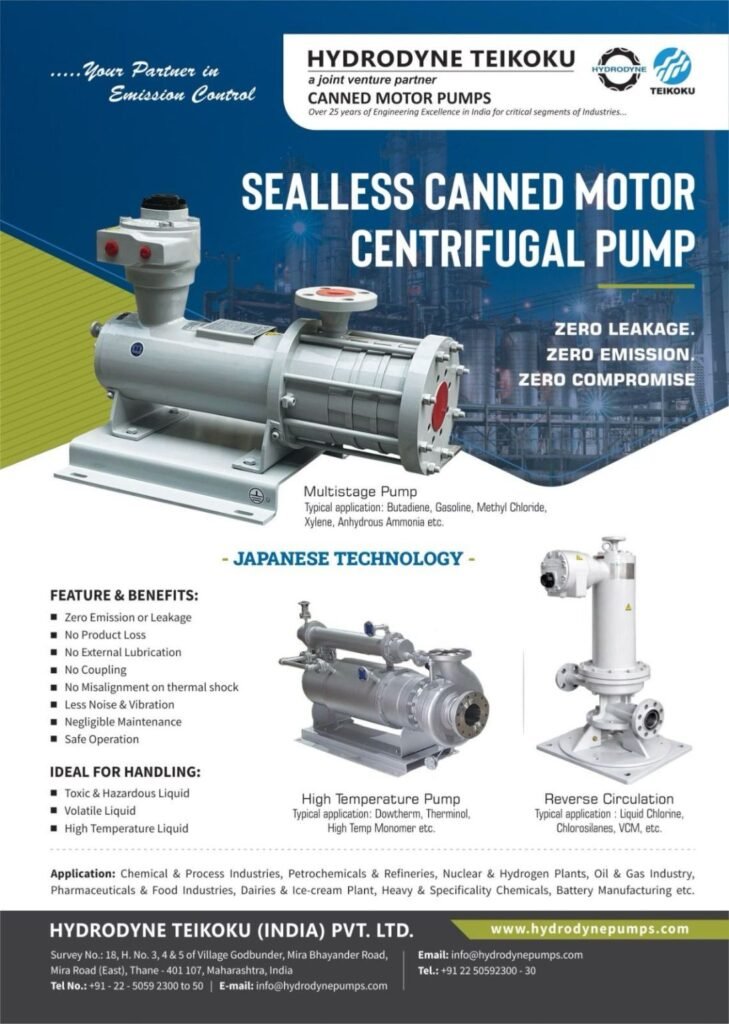
Sealless Pumps operate differently because they eliminate the external dynamic mechanical seal entirely.
That changes several cost variables at once:
- Reduced fugitive emissions
- Fewer routine interventions
- Lower contamination risk
- Reduced corrosion spread
- Less hazardous-area maintenance exposure
The biggest economic advantage often comes from avoiding recurring disruption rather than reducing component replacement cost.
And honestly, this is where many lifecycle calculations initially underestimate seal-less systems.
Why downtime becomes the dominant cost factor
Inside continuous chemical processing facilities, downtime usually costs more than equipment replacement.
This is particularly true in:
- Chlor-alkali plants
- Petrochemical facilities
- Polymer production
- VCM processing
- Speciality chemicals
- Solvent manufacturing
One unplanned shutdown may affect:
- Production throughput
- Utility balance
- Reactor conditions
- Feedstock scheduling
- Downstream processing
The pump itself becomes only a small part of the financial impact.
Reliable containment therefore carries operational value beyond maintenance reduction alone.
Why fugitive emissions now carry measurable financial exposure
Many older plants historically tolerated low-level leakage as “normal.”
That operational mindset is disappearing.
Environmental pressure has increased around:
- VOC emissions
- Toxic gas release
- Hazardous air pollutants
- Worker exposure limits
Even small chronic leakage may now create:
- Compliance reporting obligations
- Environmental penalties
- Additional monitoring requirements
- ESG performance concerns
This is where Sealless Pumps offer significant long-term operational advantages.
Because the primary atmospheric leakage pathway disappears.
Not reduced.
Eliminated structurally.
Why corrosion damage is usually underestimated in lifecycle analysis
This point gets overlooked constantly.
Small chemical leaks rarely stay localised.
Over time, chronic vapour exposure attacks surrounding infrastructure:
- Cable trays
- Instrumentation
- Pipe supports
- Electrical systems
- Coatings
- Structural steel
Plants often spend years repairing secondary corrosion without linking the cost back to recurring seal leakage.
The pump may continue operating while nearby infrastructure slowly deteriorates.
That indirect cost becomes substantial over long operating periods.
Why energy efficiency comparisons alone are misleading
Some conventional pump advocates focus heavily on energy efficiency differences.
But lifecycle economics in hazardous service involve broader operational variables:
- Maintenance frequency
- Reliability stability
- Leak prevention
- Safety exposure
- Shutdown avoidance
A pump operating slightly more efficiently hydraulically may still become operationally expensive if containment reliability remains poor.
Modern lifecycle evaluation increasingly balances efficiency against risk exposure.
Why labour shortages are changing maintenance strategy
This is becoming a major industrial issue globally.
Experienced seal technicians are harder to replace than many facilities expected.
As maintenance teams shrink:
- Planned intervention capacity decreases
- Emergency response becomes slower
- Specialist expertise becomes expensive
Plants increasingly prefer systems requiring less frequent intervention altogether.
This operational shift strongly benefits Sealless Pumps in hazardous chemical service.
Why some plants still hesitate to switch completely
There are still legitimate concerns around seal-less systems in certain applications.
For example:
- Higher upfront investment
- Sensitivity to dry running
- Internal circulation management requirements
- Process-specific application engineering
Not every process automatically benefits equally.
Poor application selection can still create reliability problems.
This is why proper engineering evaluation matters more than broad technology preference alone.
The best-performing facilities usually apply seal-less systems strategically in high-risk services first.
Where Sealless Pumps usually create the highest lifecycle value
The strongest economic advantages typically appear in applications involving:
- Toxic chemicals
- Volatile hydrocarbons
- Chlorine transfer
- Carcinogenic media
- High-temperature solvents
- Corrosive fluids
- Difficult maintenance access
In these environments, avoiding leakage and intervention often outweighs higher initial equipment cost relatively quickly.
Why modern plants increasingly calculate “risk-adjusted cost”
Traditional pump selection focused on direct cost.
Modern chemical facilities increasingly calculate risk-adjusted lifecycle cost instead.
That includes:
- Probability of leakage
- Consequence of shutdown
- Environmental exposure
- Maintenance burden
- Safety intervention frequency
This broader operational model tends to favour Sealless Pumps in hazardous service because containment reliability influences multiple financial categories simultaneously.
The operational mindset inside leading chemical plants is shifting
The industry is slowly moving away from reactive maintenance philosophy.
Historically:
“Repair leakage when it appears.”
Now:
“Prevent leakage pathways entirely.”
That sounds subtle, but it changes equipment strategy significantly.
The conversation is no longer:
“How fast can seals be replaced?”
It is:
“How can we avoid hazardous intervention altogether?”
That difference explains much of the growing seal-less adoption across chemical processing industries.
Conclusion
The lifecycle cost comparison between conventional pumps and Sealless Pumps in hazardous chemical service extends far beyond initial purchase price. Modern chemical plants must account for fugitive emissions, maintenance intervention, corrosion spread, regulatory exposure, downtime risk, and long-term containment reliability when evaluating true operational cost.
As environmental expectations tighten and maintenance complexity increases, many facilities are finding that seal-less systems provide stronger long-term economic stability despite higher upfront investment. By reducing leakage pathways and minimising hazardous maintenance exposure, Sealless Pumps help chemical plants improve reliability while lowering cumulative operational risk over extended service life.
We at HydrodynePump Teikoku support hazardous chemical industries requiring engineered seal-less pumping systems for demanding process applications. Our team helps facilities implement reliable pumping solutions designed to improve long-term containment integrity, reduce fugitive emissions, and support safer continuous-duty operation across corrosive and hazardous service environments.
FAQs
Why are Sealless Pumps considered cost-effective long term?
They reduce leakage-related maintenance, downtime, and environmental exposure costs over time.
Do conventional pump seals always leak eventually?
Most mechanical seals experience wear and gradual leakage progression during long-term operation.
What hidden costs affect hazardous chemical pump systems?
Shutdowns, gas testing, compliance procedures, corrosion repair, and maintenance labour all add significant cost.
Are Sealless Pumps suitable for toxic chemical service?
Yes. They are widely used where containment reliability is critical.
Why does downtime matter so much in chemical plants?
One process interruption may affect multiple interconnected production systems simultaneously.
Can small seal leaks damage surrounding infrastructure?
Yes. Chronic vapour exposure often accelerates corrosion in nearby electrical and structural systems.
Are Sealless Pumps replacing all conventional pumps?
Not entirely. Many plants prioritise seal-less systems in high-risk or high-maintenance applications first.