
Design Challenges in Pumping Liquid Chlorine (Cl₂) and How Canned Motor Pumps Solve Them
May 14, 2026
Failure Modes in Chlorine Pumps and How API 685 Design Prevents Them
May 19, 2026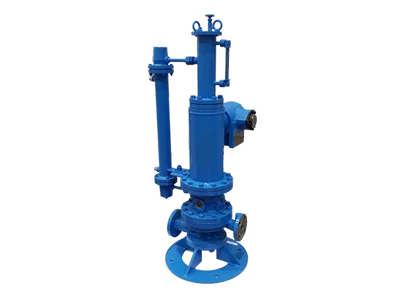
In chlorine transfer systems, the phrase Zero Leakage is not marketing language. It is an operating principle tied directly to plant safety, environmental compliance, equipment reliability, and worker protection. Chlorine is highly toxic even at low exposure levels, which means a minor leak around a pump seal, flange, or transfer line can quickly become a serious operational event.
That is why industries handling chlorine increasingly design systems around containment reliability instead of simply managing leakage after it occurs. Over time, this approach has pushed many chemical and chlor-alkali facilities toward seal-less technologies, particularly canned motor pumps, because conventional sealing arrangements often struggle to deliver truly leak-free long-term performance under aggressive chlorine service.
Why chlorine transfer systems demand a different approach
Many industrial fluids allow some operational tolerance for minor seepage or periodic seal maintenance.
Chlorine does not.
Even small leakage incidents may create:
- Operator exposure risks
- Emergency shutdown conditions
- Corrosion damage nearby
- Environmental reporting obligations
- Production interruption
- Regulatory scrutiny
The challenge becomes even more complicated because chlorine transfer systems usually operate continuously. Pumps, pipelines, valves, and storage systems remain under pressure for long operating cycles.
That means equipment reliability is tested every day, not only during commissioning.
This is where the Zero Leakage philosophy starts becoming practical rather than theoretical.
The real problem with “acceptable leakage”
Older industrial systems often treated minor leakage as manageable. In less hazardous applications, maintenance teams could monitor seals, tighten packing, or schedule periodic replacement during shutdowns.
In chlorine service, that mindset creates risk.
A very small chlorine leak may still:
- Trigger gas detection systems
- Affect surrounding equipment
- Require evacuation procedures
- Increase operator exposure
- Create long-term corrosion issues
There is also another reality chemical plants understand well.
Minor leaks rarely remain minor forever.
Seal wear increases gradually. Vibration affects alignment. Pressure fluctuations stress sealing surfaces. Eventually the system reaches a point where leakage escalates unexpectedly.
This is one reason many modern chlorine facilities no longer design around “controlled leakage.” They design around eliminating leakage paths wherever possible.
Mechanical seals remain the biggest vulnerability
In most conventional pump systems, the mechanical seal represents the primary leakage risk area.
Mechanical seals operate around a rotating shaft that passes through the pump casing. Under chlorine service conditions, those seals experience continuous stress from:
- Friction
- Pressure variation
- Temperature shifts
- Vapour formation
- Corrosive process conditions
Even advanced dual seal systems eventually require:
- Inspection
- Adjustment
- Support system maintenance
- Replacement
Over time, reliability depends heavily on maintenance quality and operating consistency.
And honestly, chlorine systems rarely operate under perfectly stable conditions all the time.
Why seal support systems are not always enough
To improve seal reliability, chlorine transfer systems often include additional support infrastructure such as:
- Seal flushing arrangements
- Pressurised barrier systems
- Cooling loops
- Leakage detection systems
- Vapour recovery setups
These systems help reduce leakage probability. But they also increase complexity.
More piping.
More instrumentation.
More maintenance points.
More opportunities for failure somewhere else in the system.
This is an important shift in thinking.
Instead of continuously managing the weaknesses of external seals, many facilities now prefer technologies that remove the external seal entirely.
How the Zero Leakage philosophy changes pump selection
The Zero Leakage approach focuses on containment at the equipment design level.
Rather than asking:
“How do we control seal leakage safely?”
The question becomes:
“How do we eliminate the leakage path itself?”
This is exactly where canned motor pump technology fits chlorine transfer applications particularly well.
How canned motor pumps support Zero Leakage systems
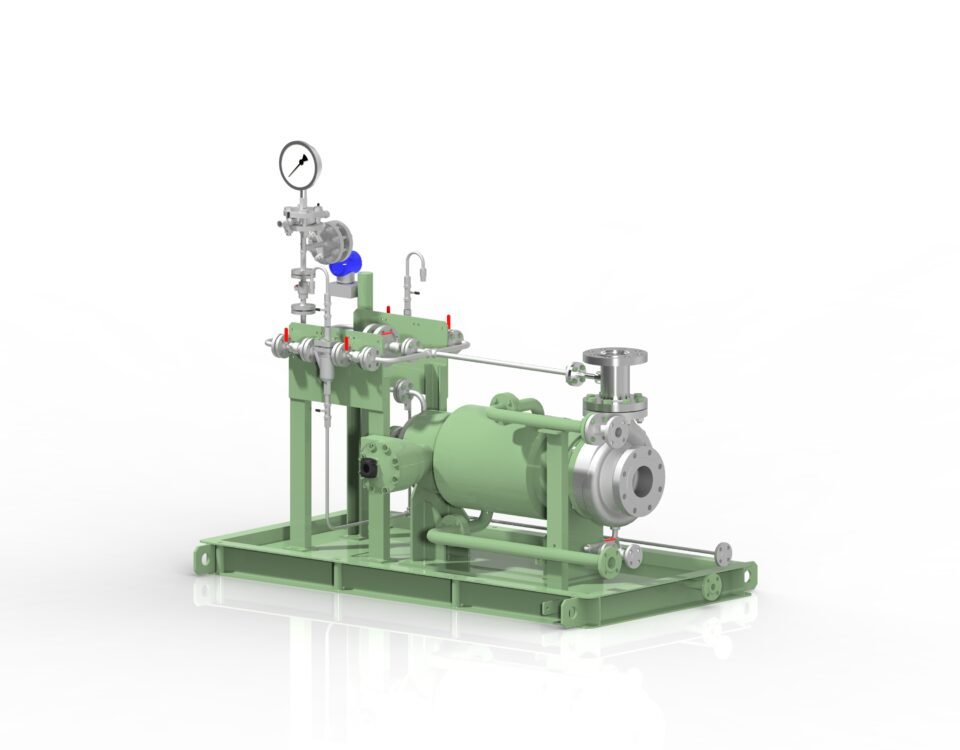
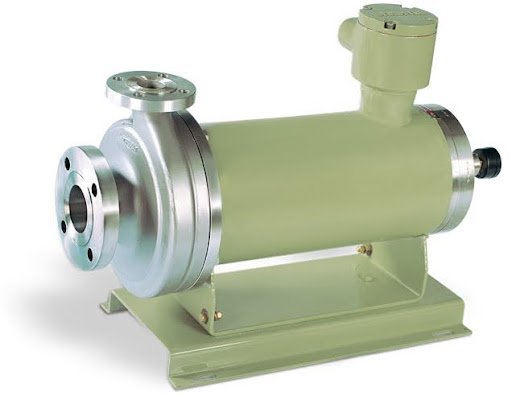
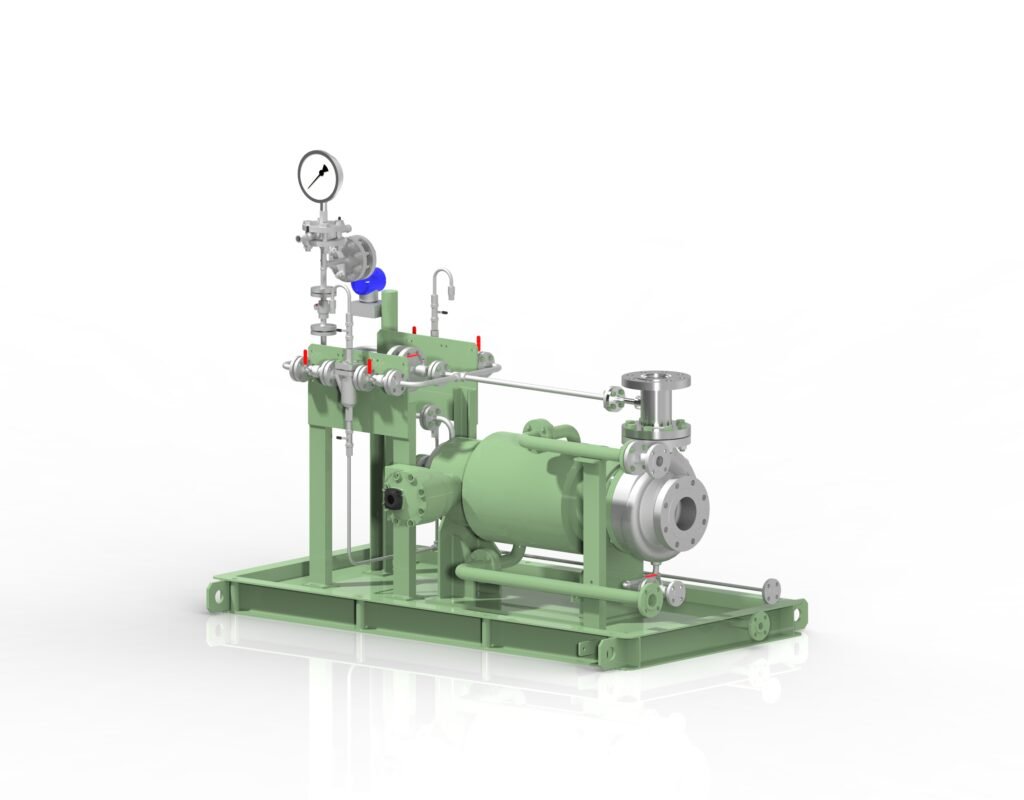
Canned motor pumps use a hermetically sealed construction where the motor and pump form a single integrated assembly.
There is:
- No external rotating shaft
- No mechanical seal exposed to atmosphere
- No coupling alignment requirement
- No external seal support system
The process liquid remains fully enclosed inside the system.
For chlorine transfer, this changes the operational risk profile significantly.
Reduced fugitive emissions
Fugitive emissions remain a major concern in chemical processing industries.
Even small atmospheric releases can create compliance issues under modern environmental standards.
By removing the external seal arrangement, canned motor pumps reduce one of the most common emission points found in conventional pump systems.
That improvement directly supports the Zero Leakage philosophy.
Better protection for operating personnel
Pump maintenance zones are often where personnel face the highest chemical exposure risk.
Mechanical seal replacement, flushing system maintenance, and leakage inspection all require close interaction with hazardous process equipment.
Seal-less systems reduce many of these intervention points.
That means:
- Less operator exposure
- Reduced maintenance frequency
- Fewer emergency repair situations
- Lower risk during servicing activities
In chlorine plants, reducing maintenance exposure is a major safety advantage on its own.
Why continuous operation matters
Most chlor-alkali and chemical processing facilities operate continuously.
Unexpected shutdowns affect:
- Production rates
- Process stability
- Downstream operations
- Utility systems
- Maintenance schedules
A leaking seal may eventually force shutdown decisions long before complete equipment failure occurs.
The Zero Leakage approach supports operational continuity by reducing the likelihood of containment-related interruptions.
This is one reason many plants view seal-less pumping technology as both a safety improvement and a reliability improvement at the same time.
Vapour formation creates additional leakage challenges
Liquid chlorine systems frequently operate near vapour pressure limits.
Temperature changes or suction instability may cause partial vapour formation inside the pump system.
Once vapour enters conventional seal areas, several problems can follow:
- Seal face instability
- Lubrication loss
- Increased wear
- Leakage escalation
- Cavitation risk
Mechanical seals generally perform best under stable liquid film conditions. Chlorine service does not always provide that stability consistently.
Canned motor pumps handle these conditions differently because they remove the external sealing interface completely.
That simplifies containment during unstable process conditions.
Corrosion control remains critical
The Zero Leakage philosophy also depends heavily on material compatibility.
Moist chlorine environments can become highly corrosive if materials are selected improperly.
Chlorine transfer systems therefore require careful metallurgy selection involving:
- Hastelloy
- Titanium
- Duplex stainless steels
- Nickel-based alloys
- Special corrosion-resistant materials
Poor material selection eventually undermines even the best sealing design.
That is why chlorine pumping systems require application-specific engineering rather than generic equipment substitution.
The hidden operational cost of small leaks
Many facilities initially evaluate pumps primarily on purchase cost.
But chlorine systems behave differently because leakage-related costs accumulate quietly over time.
A small recurring leak may lead to:
- Increased maintenance labour
- Frequent inspections
- Corrosion repair
- Regulatory documentation
- Production inefficiencies
- Safety management overhead
The direct repair cost often becomes smaller than the indirect operational impact.
This is why lifecycle reliability matters more than initial purchase price in hazardous chlorine handling systems.
Zero Leakage is also an environmental strategy
Environmental expectations in the chemical industry continue tightening.
Facilities are expected to:
- Reduce fugitive emissions
- Improve containment reliability
- Limit hazardous exposure
- Maintain safer operating conditions
The Zero Leakage philosophy aligns closely with these goals because it focuses on preventing emissions at the equipment level instead of controlling them after release.
That distinction becomes increasingly important in modern plant design.
Reliability and safety are now closely connected
Years ago, reliability and safety were sometimes treated as separate engineering discussions.
Today they overlap heavily.
An unreliable chlorine transfer system quickly becomes a safety concern.
A leaking seal eventually becomes an environmental concern.
Repeated maintenance intervention increases personnel exposure risk.
The industry has gradually recognised that stable leak-free operation supports all three areas simultaneously:
- Safety
- Reliability
- Environmental performance
That is largely why seal-less pumping technologies continue gaining wider adoption in chlorine service.
Why many plants are redesigning around containment
Older chlorine transfer systems often relied on layered protection strategies:
- Contain leakage
- Detect leakage
- Control leakage
- Respond to leakage
Modern systems increasingly focus on avoiding leakage in the first place.
That sounds obvious, but it represents a major shift in engineering philosophy.
Instead of assuming some leakage risk will always exist, the design objective becomes complete containment reliability wherever possible.
The Zero Leakage concept grew from this shift.
Conclusion
In chlorine transfer systems, leakage prevention is not simply a maintenance target or environmental requirement. It directly affects plant safety, operating continuity, personnel exposure, regulatory compliance, and long-term reliability.
Conventional mechanical seal systems can still perform effectively under certain conditions, but they often require extensive support infrastructure and continuous monitoring to maintain containment reliability over time. The Zero Leakage philosophy takes a different approach by reducing or eliminating the leakage path itself, particularly through seal-less pumping technologies such as canned motor pumps.
We at HydrodynePump Teikoku support industries handling hazardous chlorine service where containment reliability is critical. Our team helps chemical and chlor-alkali facilities implement engineered canned motor pump systems designed to support leak-free operation, safer process environments, and long-term operational stability under demanding process conditions.
FAQs
What does Zero Leakage mean in chlorine transfer systems?
It refers to designing systems that prevent chlorine leakage at the source rather than managing leakage after it occurs.
Why is chlorine leakage considered highly dangerous?
Chlorine is toxic even at low exposure levels and may create serious safety and environmental risks.
How do canned motor pumps support Zero Leakage operation?
They eliminate external mechanical seals, reducing one of the most common chlorine leakage points.
Are mechanical seals unreliable in chlorine service?
Mechanical seals can work effectively, but they require careful maintenance and remain vulnerable to wear over time.
Why are fugitive emissions important in chemical plants?
Fugitive emissions affect worker safety, environmental compliance, and long-term equipment reliability.
What materials are commonly used in chlorine transfer systems?
Special corrosion-resistant materials such as Hastelloy, titanium, and duplex stainless steel are commonly used.
Do seal-less pumps reduce maintenance requirements?
Yes. They remove many seal-related maintenance activities and reduce routine intervention around hazardous equipment.